ServicesSolar Panel Repair
Solar Panel Repair in North Salt Lake
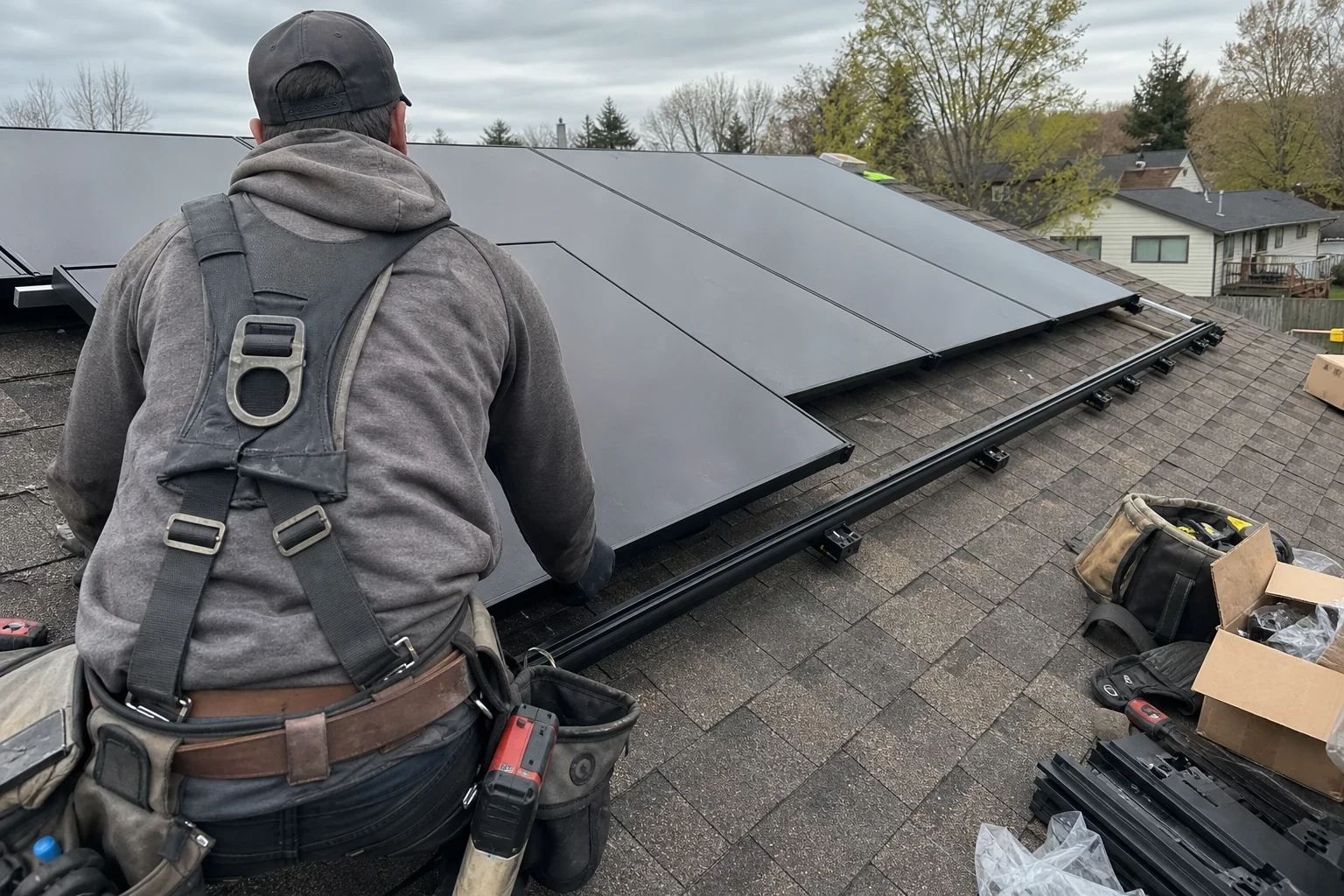
When your panels stop making the power they should, we find out why and fix it. We test the system, show you what we found and explain the fix in plain words before any work starts. Your yard and your home get treated with care the whole time.
When a repair is the right call
Most solar systems run for years without much fuss. But parts do fail. An inverter quits, a connector works loose, a panel cracks or a critter chews through a wire. You notice it when the monitoring app shows a dip or your power bill starts creeping back up.
Panel repair means finding the one part causing the trouble and fixing that part. It does not mean tearing out a system that still has years of good output left. If a repair would cost more than it is worth, we tell you that too, and we lay out your options so the whole household knows what is going on.
Hot summers and snowy winters around North Salt Lake are hard on outdoor equipment. Heat wears on inverters and freeze-thaw cycles loosen fittings, so catching a small problem early keeps it from turning into a bigger bill.
What our repair visits cover
Testing the whole system
We check output string by string with a meter and compare it to what your system should make for its size and the way it faces. That tells us where the loss is instead of guessing.
Inverter and optimizer work
The inverter tends to wear out before anything else. We pull up its fault history and put a meter on it. If it has died, we swap it out, and we do the same for microinverters and optimizers on single panels.
Wiring and connectors
Loose connectors, corroded terminals and wire with chewed or cracked insulation all cost you power and can be a safety problem. We repair or replace them and secure the wiring so it does not rub or sag.
Damaged panel replacement
Cracked glass or hot spots from failed cells drag down output and tend to get worse. We swap the bad panel for a matching or compatible one.
Getting monitoring back online
If your app went quiet, the problem may be the gateway or the Wi-Fi link, not the panels. We get it reporting again so you can see what your system is doing.
Photos and a written summary
You get pictures of what we found and a short write-up of what we fixed. It is handy for your records and for any manufacturer claim.
Signs your system needs a repair
Your bill went up, your usage did not
If nothing changed in how you use power but the bill climbed, the system is likely making less than it should.
An error code or warning light
Inverters flag problems with a red or amber light or a code on the screen. Take a photo of it. That alone often points us in the right direction.
A flat line in the app
Zero production on a sunny day means something is offline, either the equipment or the monitoring link.
One section lags the rest
On panel-level monitoring, one panel or string making far less than its neighbors usually means a failed optimizer, a bad connector or a damaged panel.
Damage you can see
Cracked glass, brown burn marks, loose or hanging wires. Do not touch these. Shut the system off at the disconnect and give us a call.
How a repair visit goes
- 1
Free virtual appointment
We start with a video call. You show us the inverter, the app and anything that looks off. A lot of the time we can narrow down the problem before anyone drives out.
- 2
A scheduled visit
We pick a time that works for your household and tell you who is coming and what they plan to check. Most of the work is outside. If we need your electrical panel in the garage or house, we lay down floor runners first.
- 3
Testing and a plain answer
We test, take photos and explain what failed and why. You get a written quote with parts and labor listed line by line before we touch anything.
- 4
The fix and the cleanup
We put tarps over plants and gravel, keep ladders out of flower beds and haul off old parts and packaging. Before we leave, we confirm the system is producing and show you the numbers.
What affects the cost of a repair
We price a repair after we know what failed. We do not toss out a number over the phone and then change it at your door. Your quote lists each part and each labor item, so you can see exactly what you are paying for.
- Which part failed
- Reseating a loose connector is a small job. Replacing a central inverter is a bigger one, both in parts and in time.
- How easy the equipment is to reach
- Panels on a tall or steep spot, or an inverter tucked behind a fence in a narrow side yard, take more setup and more labor.
- Part availability
- Older panels and inverters are sometimes discontinued. We may need a compatible model, and once in a while that means swapping a matching part as well.
- Manufacturer coverage
- Some parts may still be covered by the maker's own warranty. We check your paperwork, and if a part qualifies, we help you file the claim.
- Permits and inspection
- Some repairs, like an inverter replacement, can need a permit and an inspection. When they do, we pull the permit and meet the inspector.
Common questions about fixing a solar system
Something not covered here? (801) 845-9016
My system was put in by a different installer. Can you still fix it?
We can. Plenty of the systems we test came from other outfits, and some of those outfits have since closed up shop. We run the same checks on every system and match the parts to what you already have.
Do I need to be home for the repair?
Not for most of it, since the work is outside. We do ask that someone be there at the start and the end so we can walk through what we found and what we did. If we need inside access to your electrical panel, we set that time with you ahead of the visit.
Is it safe to keep running the system with an error code?
It depends on the error. Many codes just mean you are losing production, which costs money but is not dangerous. If you see burn marks, smell something hot or a breaker keeps tripping, switch the system off at its disconnect. Keep it off until one of us has had a look.
Should I repair it or replace the whole system?
Most of the time, repair. Panels last a long time and one failed part rarely means the rest are done. If your system is older and several parts are failing at once, we lay out the cost of both paths and let you decide. Our Solar Panel Installation page covers what a new system involves.
How long does a repair take?
A single-part repair is usually done in one visit of a few hours. If a part has to be ordered, we make the system safe, then come back to finish. A permit and inspection can add a few days.
Get your system producing again
Start with a free virtual appointment. Show us what you are seeing, and we will tell you what we think is wrong and what it takes to fix it.